Try it
Make your character
Peoples
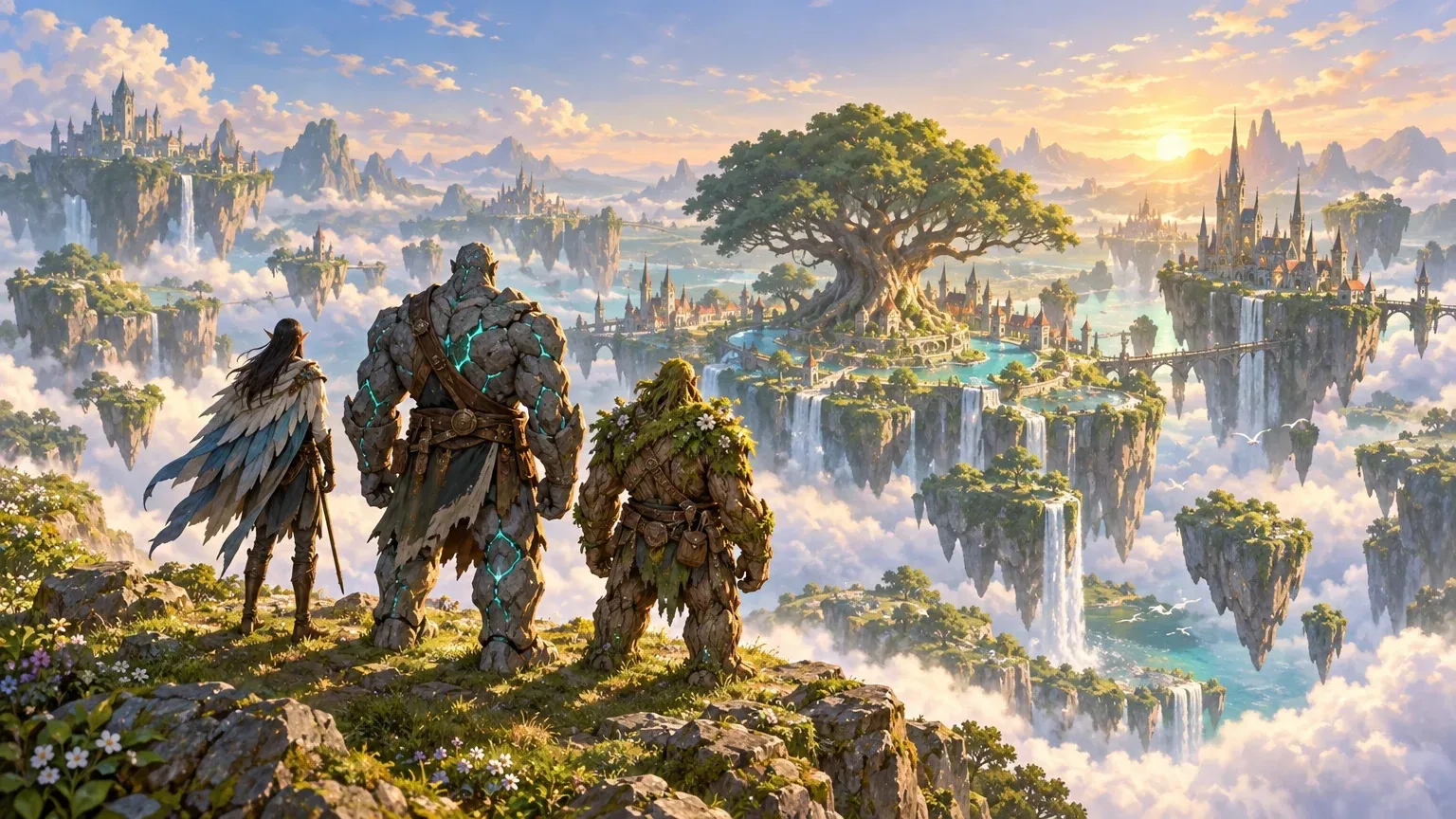
The playable peoples at launch are the Galeborne, the Anchorkin and the Rootwardens. More peoples are planned for later, and everything about peoples is built so a new one can be added without changing the others (see Adding a people).
Characters read first by people, then by gear. There are no classes: any people can follow any path. Each people has a homeland, cultural affinities, and one innate skill that only it can learn. Each people’s look, homeland, culture, first hours, relations and signature features are written on its entry in entries/peoples/.
Outfit tone for all peoples: grounded, handmade leather, cloth and forged metal, with epic details such as teal crystal, gold trim and culture motifs.
Innate skills
Innate skills follow the same rules as every other skill: they start low, rise with use (0–100) and unlock techniques. The only difference is that no other people can learn them. Each one has a clear strength and a clear limit, written on its skill entry: Glide for the Galeborne, Anchor for the Anchorkin and Take Root for the Rootwardens.
Old grudges and ties
- Galeborne vs Rootwardens: the Galeborne need ancient wood for masts and hulls. The Rootwardens say every old tree felled hastens the sinking. Grudgewood, on their shared frontier, is the oldest quarrel on the shard.
- Rootwardens and Anchorkin: old allies who hold the land: one with roots, the other with chains.
- Galeborne and Anchorkin: wary trade partners. The Galeborne carry goods across the sky and buy Anchorkin chain and stone. The Anchorkin don’t trust a people who can leave any isle the moment it starts to fall.
Adding a people
A new people is one entry file, entries/peoples/<id>.md, plus its innate skill as entries/skills/<skill>.md with innateTo: <id>. It needs:
- a look and a signature layer for customization;
- a homeland or a reason to have none (the Garden Isles in the east of the First Shard are unclaimed, kept for this);
- cultural affinities with existing skills (the
affinitylist of those skill entries); - one innate skill with a strength and a limit;
- a tie or grudge with at least one existing people.
Retired concepts
The earlier lineup of five (Rootborn, Veiled Ones, Mossbacks, Skerrin and Rillfolk) was retired in favour of this one: too many of them were beast-folk, and their player fantasy was weak. Their concept art and 3D models stay in art/ as drafts. Pitches kept for later peoples:
- Lanternborn: near-humans whose veins glow. Their light reveals storm-touched creatures and hidden paths.
- Oathbound: masked, faceless wanderers who swear oaths for strong buffs that break if the oath is broken.
Rejected in earlier rounds: Galeborn (the old wind-folk sketch), Hearthkin, Glimmerfolk, Brushtails, Hartkin, Cindrel, Shardkin, Nimbari, Lumenwings, Tidewrought, Hollow, Windspeakers.
Open questions
- Home towns within each homeland beyond the shrine isle.
- Male, female and body variation for each people.
- Exact numbers for each innate skill (glide distance, anchor hold time, regeneration rate).
Character Customization
Players build distinct characters within each of the peoples. The system uses one shared skeleton and layered, modular parts. Each people has a signature layer that gives the most creative freedom but can never be removed, so every character still reads as its people at a glance.
Layers
| Layer | What players change | How it’s built |
|---|---|---|
| 1. Body | Height, build, shoulder width, belly, age, limb length, hands, feet | Bone sliders and blend shapes on one shared base body |
| 2. Head and face | Face shape, eyes, nose, mouth, ears, brow, expression | Face sliders on the shared base, ARKit 52 expressions |
| 3. Signature features | Race-defining traits (see below) | Swappable parts on race-specific slots |
| 4. Hair, feathers, foliage | Hairstyle, beard, crest, moss | Swappable meshes and texture masks |
| 5. Clothes and armor | Outfit pieces in four layers: under, garment, armour, cloak | One kit, fitted to every people and slider by script |
| 6. Props | Trinkets, lanterns, feather charms, chain links | Attachment points on the skeleton |
Colour runs across all layers. Every texture carries primary, secondary and accent masks. Skin, feathers, stone and bark use a curated, muted palette per people so characters stay on-style; clothes use dyes.
Signature features
Each people’s signature layer, what players can change and what is locked, is written on its people entry in entries/peoples/ (the signature field), for example the Anchorkin brow Ledger line and shoulder oath-marks.
Design rules
-
One skeleton and one base mesh per body family. All peoples share the humanoid family: one skeleton (Godot humanoid bone names, with optional mantle, tail and ear chains) and one base mesh (MakeHuman’s CC0 base). Each people is a signature shape on that base, plus its own joint positions. Every bone points straight up at rest, so one animation library plays on every people, tall and light or huge and heavy.
-
Gear is made once and fitted by script. A piece is modelled once on the base body. The fitting step copies skin weights from the body and bakes one shape key for every body slider and every people, so it follows them all. Pieces declare which body regions they cover (the body hides those) and which other slots they hide (a cape hides on a Galeborne while they glide). A per-people variant is only needed where a signature breaks the shared fit, such as the Galeborne mantle.
-
Appearance is separate from stats. Players save outfit looks (transmog), so their identity survives gear swaps. This matters in a classless game with partial-loot PvP.
-
Customization ties into the economy and progression.
- Dyes are crafted items and act as a gold sink.
- Anchorkin oath-marks are added as a character keeps posts and swears vows (see Anchorkin); the brow Ledger line is set at creation and doesn’t change.
- Galeborne mantles grow longer as Glide rises.
- Rootwarden growth changes with the seasons.
Characters become more distinct the longer people play.
-
Signatures always read. Sliders are clamped: a Galeborne can’t lose its mantle and a Rootwarden can’t become smooth-skinned. Open-world PvP needs peoples to be recognisable at a distance.
Pipeline
The research behind the choices is in docs/reports/AI 3D game asset pipeline.md.
- Meshy: shapes and paint for bodies, gear, parts, props and environment pieces (the
meshyskill). - Engines: live sliders (bone offsets and shape key pairs), body regions hidden under gear, dye shaders with a toon ramp, ARKit 52 expressions, and spring bones for mantles, tails, ears and capes.
Open questions
- How many preset heads and slider ranges per people?
- Can appearance be changed after creation, and at what cost (a barber or mask-maker as a gold sink)?
- Gender and body variation per people: one base with sliders, or a second base per family?
- Which signature traits are tied to progression, and which are free from the start?