Mechanics
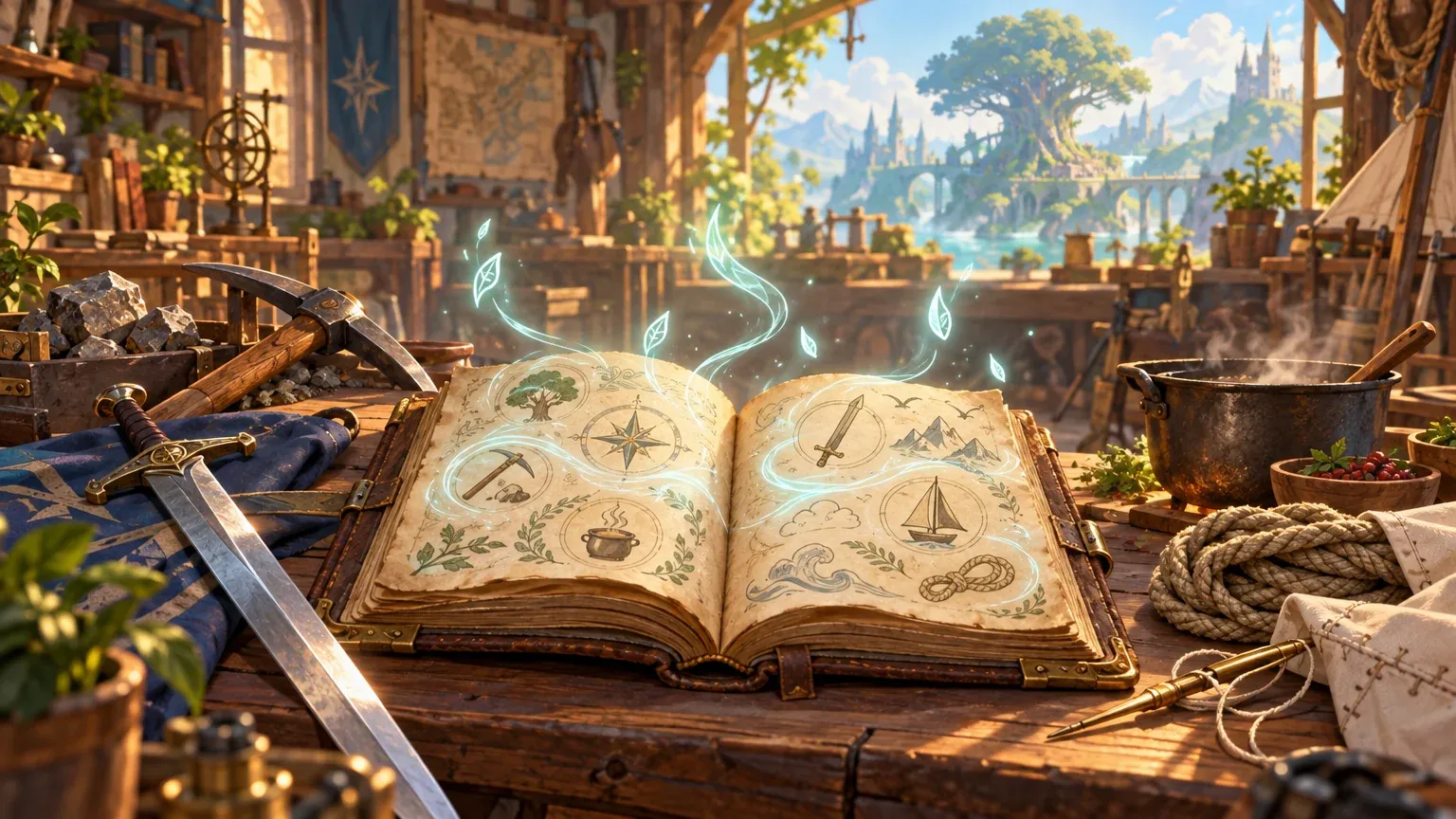
Classless, skill-based progression with action combat, open-world risk and a player-run economy. Mechanics stay simple: few systems, each easy to grasp. See the vision for the pillars.
Decisions so far
| Topic | Decision |
|---|---|
| Progression | Use-based skills, 0–100 each. Soft cap with decay: no hard total cap; unused skills decay slowly and never below half their peak, so returning to an old skill is fast |
| Everything is a skill | No separation between magic and other skills. Wind magic, swordplay, cooking and sailing all work the same way |
| Resources | No mana. One stamina bar for everything (swinging, casting, dodging, sprinting), refilling quickly at rest. Strong techniques also have their own cooldowns |
| Learning | Skills are learned at a source: a trainer, a book, or a place tied to the skill. At 75 a player can become a trainer; at 100 they can write books that teach the skill |
| Skill count | A fixed list of shared skills across combat, magic, gathering, crafting and travel (see skills), plus one innate skill per people |
| Abilities | Learned techniques from trainers and books, unlocked at skill thresholds. 6 technique slots, swapped outside combat |
| Controls | Hybrid: free-aim attacks by default, with an optional soft lock-on toggle (good for gamepad) |
| Risk zones | Three tiers, see below |
| Death | Carried resources drop at the death spot for a while; equipped gear stays but loses durability. Respawn at the nearest Accord shrine |
| Crafting | Simple recipes: recipe plus materials makes an item; skill sets the success chance and quality roll |
| Group PvE | Sinking-isle events and world bosses from storm surges. See monsters |
| Sinking | Slowed by Treetending the ancient trees (a skill anyone can learn); a sinking isle can’t be saved. Rare isle births add new land as world events |
| Gear | Wears down with use, as well as on death. Worn gear is repaired by crafters or replaced |
| Ships | Three sizes; can be attacked and cargo looted. Sails wear from attacks, weather and distance travelled. See sailing |
| Quests and achievements | Quests give direction and story; achievements record what a character has done. No endgame. See quests |
| Gear tiers | Set by material; crafting skill sets the quality within a tier. See economy |
| First hours | Start in your people’s homeland. See first hours |
| Long-term goals | Mastery and rare techniques, rare drowned-world relic gear, ships and trade empires, reputation and customization |
Risk tiers
| Tier | Where | PvP | Death |
|---|---|---|---|
| Safe | Accord towns | None | — |
| Guarded | Accord sky lanes and each people’s home isles | Consensual only (duels, flagged players) | Durability loss only |
| Wild | Contested, wild and sinking isles; uncharted wind routes | Open | Partial loot: carried resources drop |
Skills
Approved 2026-11-01 (Treetending added 2026-11-01). Every skill is learned at a source, rises by use and decays slowly when unused. Each skill, with its sources, affinities and what it unlocks at 25, 50, 75 and 100, is an entry in entries/skills/. The groups (weapons, arcane, defence and survival, gathering, crafting, travel and lore) are only for reading the list: an arcane skill works like any other.
Each people has cultural affinities but no restrictions: a skill entry’s affinity lists the peoples known for it, and any people can learn it. Each people also has one innate skill only it can learn (see peoples).
Techniques
- Each combat and arcane skill has a technique tree, unlocked at skill thresholds (25 / 50 / 75 / 100), learned from trainers or books.
- Players who become trainers can teach techniques they know, and book-writers can put them into books that others buy and trade.
- Six slots. A build is a mix, for example 3 Polearm + 2 Wind + 1 Field Medicine.
- Techniques are swapped at any time outside combat, so roles change with gear and loadout rather than a class.
- Rare and master techniques drop from world bosses and relic finds, which is part of the long-term chase.
Core loops
- Gather → craft → sell: wild isles have the best nodes, so gatherers take risk and crafters pay for it.
- Haul: sail goods between town markets. Sailweavers keep ships running, and wild routes are faster but open PvP.
- Fight: world bosses and sinking-isle events drop techniques, relic gear and rare materials.
- Sinking-isle events: an isle’s last days on a shard. Evacuate settlers, salvage relics and resources, and fight for the spoils before the isle drops into the storm layer.
Quests
Four kinds, all simple to pick up:
- Story quests for each people: hand-written chains about their history and grudges.
- Town job boards: repeatable jobs from NPCs and the world, such as hauling, gathering, hunting and escorting.
- Player-posted jobs: players post paid jobs on the same boards, for example “bring 50 iron to Windmarket”.
- World event quests: appear with sinkings, isle births, storm surges and seasons.
First hours
- New characters start on their people’s home isles, in guarded space.
- Short quests teach movement, gathering, learning a first skill from a trainer, crafting, and a skiff ride to the nearest Accord town.
- From the town, the job boards and story quests take over.
Open questions
- Exact decay rate, and whether the “half of peak” floor is per skill.
- How fast skills rise, and which actions grant gains (anti-macro rules).
- Technique counts per tree.
- Whether written books carry their author’s name.
- Which sources teach which skills, and whether some skills can only be learned in certain places.
- Base sinking cadence per shard, and how much tending slows it.
- How often isles are born, and what triggers the birth.