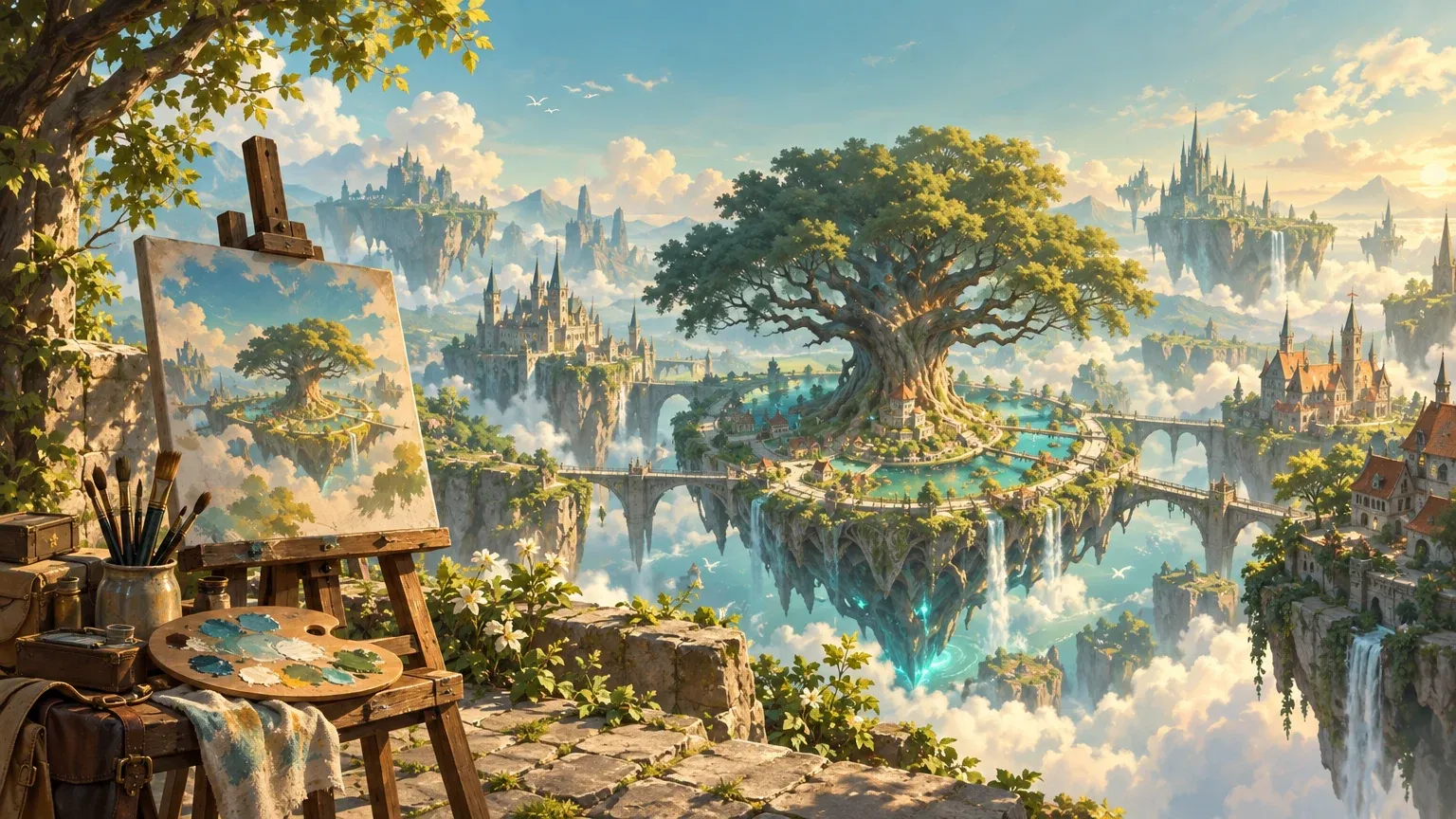
Art Direction
Stylized painterly, epic high fantasy. Grand and luminous, never grim.
Decisions so far
| Topic | Decision |
|---|---|
| Rendering | Stylized painterly: hand-painted textures, soft lighting, gentle rim light |
| Camera | Third-person, over the shoulder |
| Characters | Heroic stylized proportions: slightly larger hands, heads and shoulders, readable silhouettes at distance |
| Reference use | The reference anchors the palette and mood; other elements stay open to exploration |
| 3D fidelity | Hand-painted, mid detail: chunky readable shapes, with detail painted into textures rather than modelled |
| Peoples | Near-human peoples, each with a signature trait that always reads (see character customization), not beast-folk. The animal-folk look was retired with the earlier peoples (see peoples) |
| Colour and light | Softer and more muted than the first tests: gentler saturation, painterly atmosphere. The palette below is applied at lower saturation |
| Texture lighting | Flat, unlit colour textures (Meshy 7.1). Painterly lighting comes from in-engine shaders, not baked into textures (lighting test) |
| Time | Day and night cycle and four seasons, changing light, colour and foliage |
| Character concept format | Turnaround sheets (front, side, back) on a neutral background, used as input for Meshy image-to-3D |

Starting reference
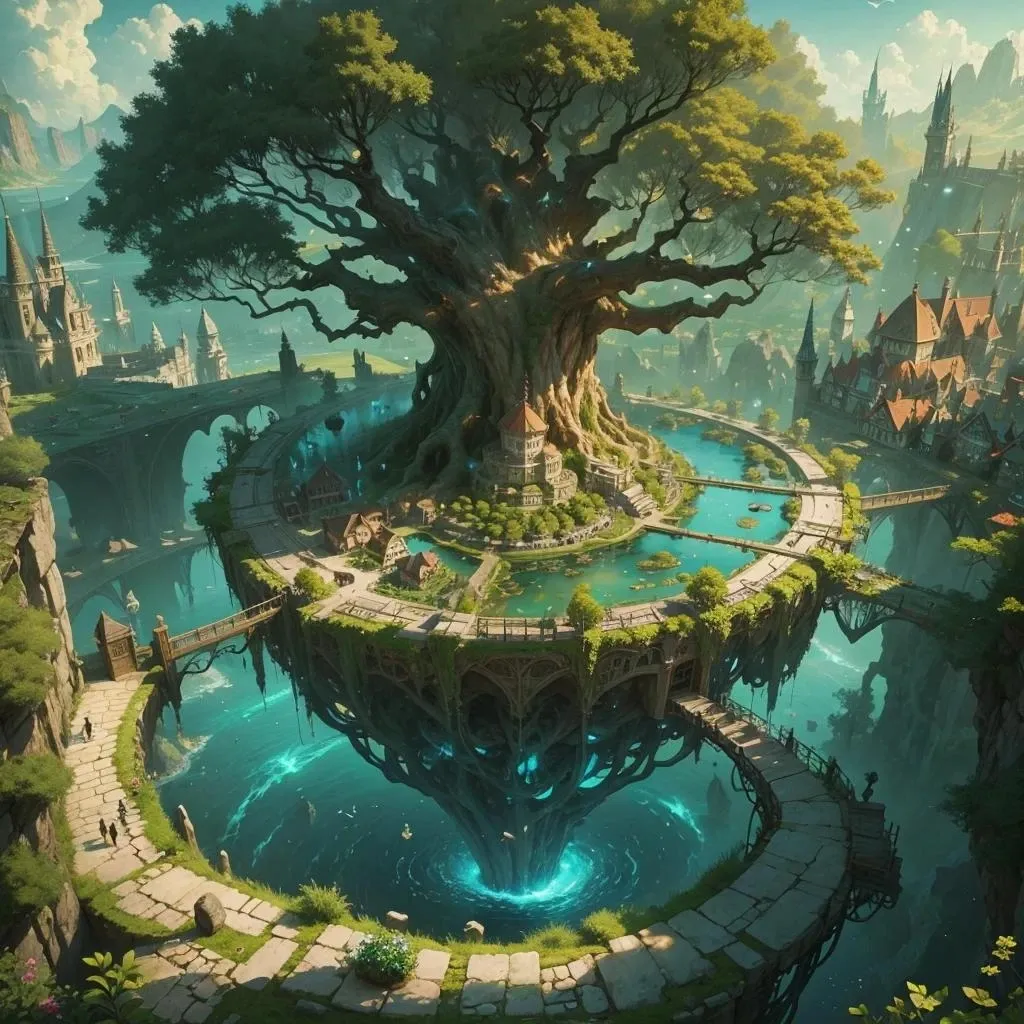
Locked: landscape style
Approved from the first style tests: market town and airship. These two images are the reference for environments.


Characters are not locked. The adventurer test read as a generic young sword hero, and character design needs its own pass.

Palette
Taken from the reference.
| Role | Colour | Hex |
|---|---|---|
| Magic and water glow | Teal | #2FC4B2 |
| Deep water and shadow | Deep teal | #0E5A57 |
| Sunlight and highlights | Warm gold | #E3B45A |
| Foliage and grass | Moss green | #4F7A3A |
| Settlements | Terracotta roofs | #C7643A |
| Stone and paths | Parchment stone | #F3ECD9 |
| Night and UI ground | Ink green | #12261F |
Visual rules
- Light: warm golden key light with cool teal shadows and fill. Magic glows teal.
- Shapes: organic, twisting forms for nature, and tall gothic spires for civilisation. Isles taper into rock and root undersides.
- Scale: huge landmarks (world tree, spires) seen at a distance give every shard a skyline.
- Detail: dense detail only near the player’s focal points. Surfaces far away read as soft painted mass.
- Readability: combat effects and enemy tells must read clearly against busy foliage, so keep effects high-contrast against the moss and stone.
Asset pipeline
- Concept art:
bun run art:imagewithopenai/gpt-image-2.5-sunburst, using the reference image as a style input. Saved toart/concept/. - 3D models: generated with the Meshy MCP from concept art, saved to
art/models/as.glb, then hand-tuned as needed.
Open questions
- How each season looks, weather, and how the sky looks below the isles
- UI style: parchment and gold, or minimal glass
- Visual identity for each biome and isle type: drafted in Biomes
Related
Architecture
Draft, under discussion. Concept sheets in
art/concept/architecture/.
Core idea: architecture answers the sinking
Every people faces the same question, how to build on land that is falling, and answers it differently. The Accord towns are where the peoples’ styles meet, and the old world left ruins in a language nobody understands. Each style’s summary, concept sheets and kit are on its architecture entry; this table is the one place its traits are written.
| Galeborne: build to leave | Anchorkin: build to stay | Rootwardens: grow, don’t build | Accord towns: where the three meet | Old world: a language nobody understands | |
|---|---|---|---|---|---|
| Silhouette | Vertical: tall narrow towers, spires, sail arcs | Horizontal: squat, broad, stepped, battered walls | Round: domes, mounds, root arches, half-buried | Crowded gables and spires around a hall and plaza | Monoliths, rings and gates |
| Structure | Tension: ropes, struts, cantilevers over the edge | Mass: thick walls, heavy arches, forged chain as structure | Growth: buttress roots, woven living walls, moss roofs | Stone ground floor, timber-framed upper floors | Exact, monumental blocks; nothing leans |
| Materials | Pale timber, cream sailcloth, whitewashed stone | Dark basalt and slate with teal crystal veins, black iron | Bark, root wood, moss, lichen, flowers | Crystal-veined basalt, deadwood timber, plaster, terracotta, sailcloth | Pale perfect stone, glyph bands, dead and lit teal channels |
| Meets the isle | Overhangs the cliff: perches, docks, landing platforms | Chained down the cliff and underside | Inside the isle: root caverns and the underside root mass | Basalt docks and stepped streets | Sunken vaults; fragments that float free |
| Doors | Tall and narrow | Huge | Low and round | — | — |
| Night light | Gold beacons and wind chimes | Teal crystal veins | Amber windows, teal fungus lanterns | — | — |
| Signature | Feather and sail motifs, weathervanes | Ledger inscription bands, oath-marks on doorposts | Flowers growing from the structure | Teal-and-gold banners, shop signs, flower boxes | Perfect geometry being reclaimed |
Scale by role
Dwellings are humble and charming, civic buildings heroic (about 3× scale), landmarks monumental. The contrast is what makes the world feel epic.
Quality rules
- Silhouette first: every building reads as a black shape at 100 m.
- No perfect geometry: lean, sag, uneven stones, chamfers, worn edges. Exaggerate big forms (oversized roofs, chunky doors).
- Painted textures on shared trim sheets per people, not flat vertex colour.
- History on every building: repairs, creeping moss, carvings, tilt on sinking isles.
- Props are miniature architecture in their people’s shape language and materials.
Concept sheets
Each style’s concept sheets are listed on its architecture entry. Each sheet shows three variants of one building or set of props side by side.
Modular architecture kit
Draft. How every building in architecture is assembled from a small set of snapping pieces. Reference sheets live in
art/kit/architecture/<style>/and follow kit sheets.
Shared rules
- Units: metres. Y up, buildings face +Z (glTF). Every piece sits on a 0.5 m base grid, so pieces from different styles can meet (Accord towns mix them).
- Pivot: bottom-left-front corner of the piece’s grid cell, on the floor plane. A wall’s thickness extends inward (−Z) from the grid line, so walls and floors meet cleanly.
- Snap edges: every piece’s open edges land exactly on module lines. Ornaments overhang freely, but never past half a module.
- Openings are inserts: doors, windows and shutters are separate pieces that drop into a standard opening, so one wall piece gives many looks.
- Materials: each style has one hand-painted trim sheet (stone courses, timber, roof, trims, signature details). Pieces are UV-mapped onto it, so the whole kit shares one material and batches well.
- Wear: variants come from the trim sheet (moss, cracks, repairs) and from a sinking variant (tilted, cracked) of the key pieces.
- Budgets: wall or roof piece ≤ 600 triangles, corner or insert ≤ 400, signature or landmark pieces ≤ 3k.
Modules per style
| Style | Horizontal module | Storey | Wall | Character of the grid |
|---|---|---|---|---|
| Anchorkin | 3 m | 4 m | 1 m thick, battered 8° inward | Wide and low; doors 2 × 3.2 m for huge folk |
| Galeborne | 2 m | 3 m | 0.3 m timber or stone skin | Narrow and tall; stacks of 3–5 storeys, cantilevered decks |
| Accord towns | 2 m | 3 m | 0.5 m | Anchorkin-style stone ground floor, timber upper floors, sail awnings |
| Rootwardens | No rectilinear grid | — | — | Sockets instead: root segments end in standard round caps (0.6, 1.0, 1.6 m, and 2.5 m great roots), tapers step between sizes, dome shells come in radii 3, 5 and 8 m with root anchors on their surface, openings are cut by azimuth and take burl inserts |
| Old world | 4 m | 6 m | 1 m, razor-clean | Monumental and exact; rings come in radii 4, 8 and 16 m, with one standard inset channel width |
Piece families
Built styles (Anchorkin, Galeborne, Accord):
- Foundations: plinth, slope step, cliff-edge foundation, cantilever deck bracket.
- Walls: plain, window, door, half-height, end cap, and the style’s signature wall (Ledger band, sail panel, timber frame).
- Corners: outer, inner, column or buttress.
- Floors and access: floor or deck tile, stairs (straight and spiral), balcony, railing.
- Roofs: straight run, hip corner, gable end, ridge cap, spire or cupola crown.
- Inserts and details: doors, windows, shutters, cornice and trim strips, lanterns.
- Signature attachments: chains and mooring rings (Anchorkin), sails, masts and rigging (Galeborne), awnings and banners (Accord).
Rootwardens: root segments (straight, bend, fork, flare-to-ground), dome shells (quarter, half, full), door and window burls, moss and flower caps, pod shell, hanging roots, lantern fungus.
Old world: monolith blocks, wall slabs, arch and ring segments (90° and 45°), floor slabs with channels, column, steps, broken and tilted variants of each.
Reference sheets per style
Each style has five sheets. Views, layout, labels and the scale figure are set in kit sheets.
| Sheet | Type | Shows |
|---|---|---|
kit-structure | pieces | Foundations, walls, corners, floors and stairs |
kit-roofs (Old world: kit-rings, Rootwardens: kit-shells) | pieces | Roof pieces and crowns, or ring/arch segments, or dome shells |
kit-details | pieces | Inserts, trims and signature attachments |
kit-assembly | assembly | An exploded view of one building being assembled from the kit, plus three buildings from the concept sheets rebuilt only from kit pieces |
materials | materials | The trim-sheet swatches: 6–8 painted tiles |
Kit reference sheets
Draft. The one spec for every kit reference sheet. Sheets live in
art/kit/<kind>/, paintings inart/concept/. Prompts are built from this page bybun run art:kit, so a change here changes every new prompt.
Purpose
The concept docs say what a thing is. The paintings say how the world looks. A kit sheet says how to build it: it is the drawing a modeller (or Meshy) works from to make a game asset.
So a kit sheet is not a painting. It shows each piece alone, flat-lit, at true scale, from the views a model needs, with nothing in the way. It is drawn for a game that must run well and read clearly at low resolution and at a distance.
Where a kit sheet and a painting disagree on style, the painting wins. Where either disagrees with the concept text, the text wins.
Decisions
| Topic | Decision |
|---|---|
| One spec | Every kit sheet follows this page. Prompts are composed from the templates below, not written out by hand |
| Background | Plain light neutral grey, no scene, no sky, no floating rock. Only a soft contact shadow under each piece |
| Light | Flat, even studio light with no cast shadows and no rim light. Warm gold and cool teal stay as painted colour, never as baked lighting, because textures are unlit (art direction) |
| Scale figure | A plain human silhouette at true scale on every sheet that shows size: 1.8 m by default, or the height of the people the kit is built for (Anchorkin 2.6 m, Galeborne 1.9 m, Rootwardens 1.6 m) |
| Labels | Reference sheets carry small neat labels and dimensions. Sheets that go straight into Meshy (base bodies, single parts) carry no text at all |
| Location | Kit sheets in art/kit/<kind>/, each with a .json sidecar of the same name |
| Textures | One trim sheet per kit; every piece of the kit maps onto it (modular kit) |
| Detail | Detail is painted, not modelled. Shapes stay chunky and readable as a silhouette |
Sheet types
| Type | Use for | Views | Aspect | Labels |
|---|---|---|---|---|
pieces | Modular kit pieces: architecture, nature, ships, clothing layers | Orthographic front elevation of each piece, plus a small three-quarter view beside it, on faint module grid lines | 16:9 | Name and size under each piece |
assembly | How a kit builds things: an exploded building, an isle, a ship | Exploded view with leader lines, plus three finished builds in three-quarter view | 16:9 | Piece names, build names |
materials | Trim-sheet swatches, terrain textures, resource tiers | Square tiles flat-on, no perspective, seamless-looking | 16:9 | Name under each tile |
turnaround | A creature or a dressed character | Front, side and back in a neutral pose, one three-quarter action pose, callouts of head, hands or feet, and one texture swatch | 16:9 | Small callout labels |
variants | Swappable parts on one body: signature features, horns, masks, wear states, tiers | A grid of the same base with one part changed per cell | 16:9 | Variant name per cell |
body-plan | The shared base body of a creature body plan, with its sockets | Front, side, back and top views of one neutral, featureless body in a relaxed standing pose, sockets marked as small numbered rings | 16:9 | Socket names, real size |
body-parts | The swappable parts of a body plan, by socket | Each part alone in side view, in one row per socket, every part ending in the same socket cap | 16:9 | Part name under each, socket per row |
species | One creature built on its body plan | Side and three-quarter views of the assembled creature, its chosen parts pulled out with leader lines to their sockets, its colour mask swatches, and the storm-touched variant if it has one | 16:9 | Part names, plan name, real size |
gear | Props, weapons, tools, tack and stations | Each item three-quarter front, laid out in rows by family or tier | 16:9 | Name under each item |
base-body | The rig-ready base body of a people, as Meshy input | Front, side and back, side by side with wide gaps | 21:9 | None |
part | One part or prop, as Meshy input | Three-quarter front, one object only | 1:1 | None |
A pieces, assembly or materials sheet belongs to one kit. A style’s full set is listed in modular kit; a biome’s is nature (pieces) and terrain (materials).
Layout rules
- Background: plain light neutral grey. No scene, sky, clouds, ground plane or floating rock. A soft contact shadow is the only shadow.
- Isolation: every piece stands alone with clear space around it. Nothing overlaps, nothing touches the image edge.
- Rows: tidy rows by family, largest pieces first. One family per row where it fits.
- Views: orthographic front views are true elevations: no perspective, so sizes can be measured. Three-quarter views are small and sit beside the front view.
- Grid: kit sheets draw faint module grid lines at the kit’s module (modular kit), or 0.5 m for nature.
- Labels: small neat hand-lettered labels under each piece, with its size where it matters (
3 × 4 m). A short title at the top names the kit and sheet. Labels must match the piece names in the kit’skit.json; where a drawn label is wrong, the manifest wins and says so innotes. - Scale figure: a plain neutral human silhouette, labelled with its height, at true scale to every piece on the sheet. Put it beside the side view on turnarounds. State the subject’s real size in the prompt (a 40 cm owl reaches the figure’s knee), or the image model draws everything human-sized.
- Consistency: every sheet of one kit shares background, light, palette, brushwork and figure. Generate them in one chat or with the same references.
- References: the first attached image is always the style reference (a locked style test). Later attachments are the approved design to keep: the people’s turnaround, the creature’s painting, the concept sheets the kit must rebuild.
Game-asset rules
These keep every asset cheap to draw and clear on a small screen. A sheet that breaks them is redrawn before anything is modelled.
Shape and silhouette
- Silhouette first. Every asset reads as a flat black shape at its usual distance: a building at 100 m, a creature at 30 m, a weapon in the hand at 10 m.
- Chunky shapes. Exaggerate big forms: oversized roofs, chunky doors, big hands, thick blades. Small forms merge at low resolution, so leave them out or paint them.
- No thin geometry. Nothing thinner than about 5 cm on a 1.8 m figure. Ropes are solid rope, blades are thick, fingers are thick. Rigging, fringes, whiskers, chains of small links and fine lace are painted on or drawn as alpha cards.
- Foliage as masses. Trees and plants are a few large leaf clumps, not single leaves. Fine leaves and grass are alpha-cutout cards from the 2 × 2 sprite atlases in
art/textures/foliage/. - A few silhouettes. Two or three distinct shapes per species or piece type, not many near-copies.
Detail and texture
- Detail painted, not modelled. Cracks, carvings, stitching, bark, feathers and scales are painted into the texture at broad, clumped brushwork. No tiny high-frequency noise: it shimmers when mipmapped.
- Flat colour. Textures are unlit. Sheets show surface colour under even light so the drawing can be read straight into a texture.
- One trim sheet per kit. Every piece of an architecture, nature or ship kit maps onto its kit’s one trim sheet, so the kit is one material and batches. The
materialssheet shows its swatches (6–8 tiles). - Texture size. 1024 px per kit trim sheet, per creature and per base body; 512 px per gear piece, prop or part; 2048 px only for colossal creatures and hero landmarks. Meshy outputs 2K textures; they are scaled down on import.
- Colour masks. Characters, gear and dyeable props carry primary, secondary and accent masks (character customization), so one texture gives many colours. Draw them in clear colour zones.
Palette
- Use the palette at lower saturation. One main hue and one secondary per piece, plus at most one accent.
- Keep large surfaces soft and muted so characters and effects read against them.
- Saturated colour and glow are kept for points of interest: teal crystal, glowweed, lit channels, flowers. Glow is emissive in the engine, so draw it as a clear separate zone.
Budgets and LOD
Triangle budgets live with the thing they budget; this page does not repeat them.
| Asset class | Budget |
|---|---|
| Architecture pieces | Per family in the kit manifest docs, with the shared rule in modular kit |
| Nature pieces | Per family in the kit manifest docs; each piece’s tris in its kit.json |
| Base bodies, parts, props, weapons | Face counts per asset type in the Meshy settings (.claude/skills/meshy/references/settings.md) |
| Creatures | Small (up to 1 m) 3k, medium (up to 3 m) 8k, large 15k, colossal 30k |
| Ship kit pieces | Hull sections 1.5k, sails and rigging 800, fittings 400 |
LOD-friendly drawing:
- Big forms and small attachments are drawn as separate pieces, so a lower LOD can drop the attachments and keep the silhouette.
- Nothing important depends on a small modelled detail. If a detail matters at distance, make it a big shape; if not, paint it.
- Repeated pieces (shingles, planks, chain links) are one strip on the trim sheet, not many modelled parts.
Separable parts
- Openings are inserts. Doors, windows and shutters are drawn as their own pieces beside the walls they fit (modular kit).
- Gear is layered. Clothing is drawn by layer (under, garment, armour, cloak), each piece on its own, so it can be fitted once and worn by every people.
- Swappable features apart. Horns, masks, crests, tails, shells, growths and tack are drawn on their own
variantsorpartsheets, never fused to a base body. - Attachment shown. A piece that sits on another (overgrowth on a block, a saddle on a creature) is drawn alone, with a dotted outline or simple silhouette of what it attaches to.
Rig-ready rules
For characters and creatures that will be rigged.
- Base bodies are bare. Plain fitted underclothes only: no props, capes, belts, tails, shells or swappable features. Those break rigging when fused to the body.
- A-pose with gaps. The auto-rig finds joints from the gaps at the armpits, crotch and fingers. Bridged or closed gaps give misplaced joints, fused fingers and arms that drag the torso skin. Keep the pose sentence of the
base-bodytemplate word for word. - Same in every view. The figure is mirror-symmetric and identical in front, side and back.
- Creatures: neutral standing pose with legs apart and straight, wings spread clear of the body, tail clear of the legs, mouth closed. Fins, tails and wings are thick enough to skin.
Rig-ready checklist, checked on the image before any Meshy credit is spent:
- Gap under each arm, all the way up to the armpit; arms 30–60° from vertical, elbows straight.
- Five fingers per hand with visible gaps, thumb apart from the palm. Closed fingers still rig, but as a mitten.
- Gap between the thighs; legs straight; feet flat, pointing forward, shoulder-width apart.
- Nothing bridges a gap: no hair, beard, feathers, moss, cloth or tail joining an arm to the body or the legs to each other.
- The figure is mirror-symmetric and the same in all three views.
Naming and location
Kit sheets live under art/kit/, by the same kinds as the catalogues. Paintings stay in art/concept/.
| Kind | Folder | Sheets |
|---|---|---|
| Architecture | art/kit/architecture/<style>/ | kit-structure, kit-roofs (or kit-rings, kit-shells, kit-roots), kit-details, kit-assembly, materials |
| Nature | art/kit/biomes/<biome>/ | nature, terrain |
| Ships | art/kit/ships/ | <ship> (the ship’s own sheet), shared kit kit-hulls, kit-deck, kit-sails, kit-rigging |
| Creatures | art/kit/bestiary/ | <creature> (a species sheet, or a turnaround for older sheets), mount-tack |
| Body plans | art/kit/bestiary/body-plans/ | <plan>-body (body-plan), <plan>-parts (body-parts); plans are listed in monsters |
| Peoples | art/kit/peoples/<people>/ | base-turnaround (a base-body sheet), signatures, outfits, single parts as <part> |
| Shared gear | art/kit/peoples/gear/ | clothing-kit, armour-tiers, weapons-melee, weapons-ranged |
| Skills, materials | art/kit/skills/, art/kit/materials/ | gathering-tools, crafting-stations-<n>, woods, metals |
| Meshy views | art/kit/views/ | <subject>-front, -side, -back: crops of a base-body sheet |
- File names are lowercase kebab-case. The stem is the sheet id that
kit.jsonrefers to inref.sheet. - Every image has a
.jsonsidecar with the same stem:prompt,kit(sheet type, subject, figure height),refs, and eithermodelandgenerationId(art:image) orchat_urlandtool(chatgpt.com). - A redrawn sheet replaces the old file in place. Git keeps the history.
Making a sheet
- Pick the sheet type and write the subject: what is on the sheet, in rows, with real sizes and materials. Take names and sizes from the concept doc and the kit’s
kit.json. For a creature, give its real size. For abase-body, give the people, its body and what it is drawn without (its swappable feature). One sentence or several; the builder adds the final full stop. - Build the prompt:
bun run art:kit <type> "<subject>" [--figure 2.6] [--title "Anchorkin kit: structure"]prints it. Paste it into chatgpt.com with the references attached, or generate directly withbun run art:image --kit <type> "<subject>" --ref <style ref> --ref <design ref> --out art/kit/<kind>/<sheet>. - Review the image against the checklist below. Redraw on any miss; a sheet reroll is far cheaper than a model.
- Update the kit’s
kit.json(piece names, sizes,ref) to match the accepted sheet.
Prompt templates
The builder reads this section. Each ### heading is a block; its fenced text is the block. {name} pulls in another block, {subject} is the subject, {figure} the scale figure height in metres, {title} an optional title line. Sheet types also carry an Aspect line. Edit the words here, not in scripts.
style
Locked painterly style: hand-painted stylized game art, chunky readable shapes, detail painted not modelled, mid-level detail, softer muted colours with gentle saturation, epic and luminous, never grim. The palette's warm gold and cool teal are painted into the surfaces, but the light is flat, even studio light: no strong key light, no cast shadows, no rim light.refs
Use the attached images only as reference as described: the first attachment is always the style reference for palette and brushwork; later attachments are the approved designs to keep.sheet
Game-asset reference sheet for 3D modelling, wide landscape 16:9. Plain light neutral grey background, no scene, no sky, no clouds, no floating rock, no ground plane, a soft contact shadow only. Every piece fully isolated with clear space around it, nothing overlapping, nothing touching the edge, arranged in tidy rows, each with a small neat hand-lettered label underneath.scale
One plain neutral {figure} m human silhouette labelled "{figure} m" stands on the sheet once, for scale, with everything at true scale to it. A piece too small to read at true scale is drawn enlarged as an inset, with a small true-scale copy beside the figure and "enlarged" in its label. Write a size in a label only when the subject gives that size; never invent one.meshy
Hand-painted stylized game art, mid-level detail, chunky readable shapes, softer muted colours. Plain light grey background, even soft lighting, no cast shadows, no text, no labels.pieces
Aspect: 16:9
Please generate an image. {style} {refs} {sheet} MODULAR KIT PIECES sheet: {subject}. Show each piece as an orthographic front elevation (no perspective) with a small three-quarter view beside it, on faint module grid lines, with its name and size (for example "3 x 4 m") in the label. Thick, solid forms, no thin parts. {scale} {title}assembly
Aspect: 16:9
Please generate an image. {style} {refs} {sheet} KIT ASSEMBLY sheet: {subject}. Left half: an exploded view of one build, its kit pieces pulled apart along the module lines with thin leader lines and small piece labels. Right half: three finished builds made only from the same kit pieces, each in three-quarter view, isolated on a faint grid footprint and labelled. Use only pieces from the kit's other sheets. {scale} {title}materials
Aspect: 16:9
Please generate an image. {style} {refs} Material swatch sheet, wide landscape 16:9, plain light neutral grey background. Square swatch tiles in a neat grid, evenly spaced, each flat-on (orthographic, no perspective, no horizon, no shadows from outside the tile), a seamless tileable painterly texture with edges that would wrap, broad clumped brushwork, no tiny high-frequency noise, a short neat label under each. Swatches: {subject}. {title}turnaround
Aspect: 16:9
Please generate an image. {style} {refs} {sheet} TURNAROUND sheet: {subject}. Keep the exact design in the second attachment. Show front, side and back views in a neutral standing pose with limbs apart and clear of the body, one three-quarter action pose, close-up callouts of the head and of the hands, feet or claws, and one square texture swatch of its skin, fur, feathers or scale. {scale} Place it beside the side view, at TRUE scale to the stated size. {title}variants
Aspect: 16:9
Please generate an image. {style} {refs} {sheet} VARIANTS sheet: {subject}. Keep the exact base design in the second attachment. Show the same base in a neat grid, one part changed per cell, everything else identical, each cell labelled with the variant name. Swappable parts are shown clearly separate from the body where they attach. {title}gear
Aspect: 16:9
Please generate an image. {style} {refs} {sheet} GEAR AND PROPS sheet: {subject}. Each item alone in three-quarter front view, in rows by family or tier, with thick chunky proportions: thick blades, solid rope, chunky grips, no thin parts. {scale} {title}base-body
Aspect: 21:9
Character base-body turnaround sheet for 3D modeling and rigging: the same character shown three times side by side, evenly spaced with wide gaps, not overlapping: front view, side view, back view. The character: {subject}. Rigging A-pose: standing straight, arms straight and angled 45 degrees down and out from the body with a clear gap between each arm and the torso all the way to the armpit, elbows straight, hands open and flat with palms facing forward, all five fingers spread wide apart with a visible gap between every finger, the thumb clearly separated and pointing away from the palm, slightly oversized hands with thick fingers, legs straight with feet shoulder-width apart and a clear gap between the thighs, feet flat pointing forward, head facing forward. Hair, beard and growths stay clear of the armpits and the gap between the legs and never join an arm to the body. Wearing only simple plain fitted undershirt and short trousers, no harness, no belts, no tools, no accessories, no cape, no tail. Full body, fully visible. {meshy}body-plan
Aspect: 16:9
Please generate an image. {style} {refs} {sheet} BODY PLAN BASE BODY sheet for a modular creature kit: {subject}. Draw one neutral, featureless base body (no head detail, no horns, no ears, no tail tip, smooth plain skin) in a relaxed standing pose with the limbs apart and clear of the body, shown as front, side, back and top views in orthographic projection. Mark every socket where a swappable part attaches as a small numbered ring with a short label (for example "1 head", "2 horns", "3 tail"). Thick, solid forms; even proportions that can be stretched to make larger or smaller species. Only the base body and its socket labels: no parts, heads, horns, coats or tails anywhere on this sheet, because the parts have their own sheet. {scale} {title}body-parts
Aspect: 16:9
Please generate an image. {style} {refs} {sheet} BODY PLAN PARTS sheet for a modular creature kit: {subject}. One row per socket, labelled with the socket name at the left. Each part alone in side view, all parts in a row ending in the same round socket cap so any of them fits the same base body. Chunky readable shapes, nothing thin, colour kept to soft greyscale with painted texture so species colour can be applied as a mask. {title}species
Aspect: 16:9
Please generate an image. {style} {refs} {sheet} SPECIES sheet for a creature built from a shared body-plan kit: {subject}. Keep the base body and parts from the attached kit sheets and the creature's design from the attached plate. Show the assembled creature in side view and three-quarter view at the centre; around it, each part it uses pulled out with a thin leader line to its socket and a small label naming the part. Below: a row of four square colour mask swatches (main, secondary, accent, pattern). Show a storm-touched variant, small at the right in side view and labelled, only when the subject names one; otherwise draw no variant at all. Show only the parts this creature uses, and no description text. {scale} Place it beside the side view, at TRUE scale to the stated size. {title}part
Aspect: 1:1
A single object shown alone as a game asset, three-quarter front view: {subject}. Thick chunky proportions, nothing thin. {meshy}Review checklist
A sheet is accepted only when every line holds. Read the image; don’t trust the prompt.
- Plain light grey background; no scene, sky or ground; only contact shadows.
- Flat even light; no cast shadows or rim light painted into the surfaces.
- Every piece isolated, nothing overlapping or cut off by the edge.
- Matches the locked style and the approved design it was given (same people, same creature, same materials).
- The scale figure is there (where the type needs one), labelled, and every piece is at true scale to it.
- Views are the ones the type asks for; front views are orthographic.
- Labels are legible and match the names and sizes in the concept doc and
kit.json. Meshy-input sheets have no text. - Silhouettes read as black shapes at thumbnail size (shrink the image to 256 px wide and look).
- No thin geometry; detail is painted, not modelled; no fine noise.
- Colours stay muted; glow only on points of interest.
- Swappable parts are apart from the body; inserts apart from walls.
- Rig-ready sheets pass the rig-ready checklist.
- Saved in
art/kit/<kind>/with a.jsonsidecar.
Open questions
- Are the creature and ship budgets right? Check them against the first rigged creature and the first ship in the engine.
- Is 1024 px enough for a kit trim sheet seen up close in towns, or do Accord towns need 2048 px?
- Should every piece sheet also carry a small silhouette row (pieces as black shapes) to check readability on the sheet itself?
- Do dressed characters need their own turnaround type, separate from creatures, once outfits are modelled?
Related
- Art direction for the style, palette and pipeline
- Modular kit for grids, snapping and the sheet set per style
- Architecture, biomes and character customization for what the sheets must show
Biomes
Draft. Concept sheets in
art/concept/biomes/<biome>/. The look of each of the seven biomes inworlds/first-shard.world.json: ground, rock, plants, water and what makes each one recognisable. It is the brief for the nature and terrain concept sheets and kits, as architecture is for buildings.
Sources: the isle entries and paintings (entries/isles/, art/concept/isles/), materials and creatures. Where the paintings disagree with this doc, this doc wins.
Shared rules
Altitude sets the mood. The shard is a vertical world, and each biome sits at its own height above the storm layer, so the look runs from cold and bare at the top to wet and glowing at the bottom.
| Altitude (m above the cloud sea) | Biomes | Character |
|---|---|---|
| 30 to 50 | Crag | Thin air, wind, bare rock, sparse alpine growth |
| 10 to 35 | Roothold, forest | Old growth, deep shade, giant trees |
| 0 to 20 | Meadow, garden | Open, tended, sunlit; the shard’s middle ground |
| −5 to −25 | Lagoon | Wet, dim, teal glow; the storm flickers below |
| −45 to 10 | Ruin | Pale, broken, alien; mostly low and sinking |
Every isle has three layers, and each biome defines all three:
- Top: ground cover, plants, paths, water.
- Lip: the rounded edge where soil meets rock: overhanging grass, roots, ledges.
- Underside: the rock that tapers to a point, with the biome’s stone, roots and hanging growth. It is seen from bridges, ships and gliding, so it is as important as the top.
Tier shows on the land. Safe isles are tended: mown grass, swept paths, planted beds. Guarded isles are managed but rough. Wild isles are raw: long grass, deadfall, exposed rock, no paths.
Sinking shows on the land. A sinking isle tilts a few degrees, its lip cracks and crumbles, plants on the low side wilt and brown, and dust and stones stream from its underside. Newborn isles are bare fresh rock with the first moss, pioneer grass and no trees.
Seasons (decided: four) change colour more than shape: spring adds blossom and fresh green, summer is full and gold-lit, autumn turns leaves amber and red, winter frosts the crags and bares the deciduous trees. Evergreen biomes (crag pines, roothold moss) change least. Seasons are a shader and texture swap, not new models.
Readability. Ground stays soft and muted so characters and combat effects read against it. Saturated colour and glow are kept for points of interest: flowers, fungus, crystal, water.
Painterly, not realistic. Chunky readable shapes and clumped foliage masses (like the approved style tests), detail painted into textures, a few silhouettes per species rather than many.
The seven biomes
Roothold
Elderroot, Rootmother, Deephold, Hollowgrain. The Rootwardens’ home among the oldest trees, 10 to 30 m up.
- Mood: ancient, shaded, sacred; green-gold light through a high canopy, glowing fungus at dusk.
- Ground: deep moss over dark loam, leaf litter, roots breaking the surface everywhere. Paths are packed earth between roots.
- Rock: mossy grey granite and slate (Deephold is quarried in steps). The underside is wrapped in huge roots that trail down into the clouds.
- Trees: the ancient tree (one per shrine isle, landmark scale, 30 to 50 m), oak and elder, birch and cedar; Hollowgrain’s tree is hollow and open to the sky.
- Understory: ferns, root arches, fallen trunks, lichen-covered boulders, teal glowing mushrooms, seedling terraces on Rootmother.
- Water: springs that seep from roots and fall as thin waterfalls from the lip.
- Signature: roots at every scale, from ground cover to the isle’s underside.
- Creatures: rootcrawlers in the caverns, bark owls in the hollows.
Crag
High Spire, Featherfast, Ironcleft, Gale Stair (Galeborne), and the wild Ironreach, Cinderkey, Stormbite, Ashfall. The highest isles, 30 to 50 m up, except the low wild ones.
- Mood: windswept, vertical, bright and cold; long views, streaming cloud.
- Ground: thin alpine turf in patches over bare stone, scree slopes, wind-flattened grass and small bright flowers in sheltered ledges.
- Rock: cragslate: grey-blue, layered and sharp, with no ore seams on the Galeborne isles, broken into ledges and natural stairs (Gale Stair), split by clefts (Ironcleft). Wild crags are darker: cinder-black rock with glinting ore seams (Cinderkey, Ironreach), scorched black with storm-glass veins (Stormbite), ash-grey and crumbling (Ashfall, sinking).
- Trees: few: wind-bent pines and stunted junipers clinging to ledges, growing sideways from cliffs.
- Understory: cushion plants, lichen, alpine flowers, tumbled boulders, drake nests on the peaks.
- Water: snow on the highest peaks in winter, thin falls blown to spray by the wind.
- Signature: height and wind: spire silhouettes, ledges, everything leaning one way.
- Creatures: cliff goats, crag drakes, stonewing bats, gale hawks; skyrays around Stormbite.
Meadow
Accord Hall, Tetherport, Windmarket, Lanterncross, Oathgate, Waystone, Last Light. The open middle ground, 0 to 20 m up, and home to the Accord towns.
- Mood: open, warm, welcoming; the classic sunlit sky isle of the approved style tests.
- Ground: rolling grass, long at the edges and mown in towns, drifts of wildflowers, hedgerows, clover.
- Rock: pale limestone, warm cream with soft weathering; quarried on Waystone. The underside is pale rock with grass and ivy hanging over the lip.
- Trees: meadow birch, orchard trees (apple and pear with spring blossom), lone broad oaks as landmarks, hedge rows.
- Understory: wildflowers, bushes, standing stones, low dry-stone walls.
- Water: reflecting ponds (Accord Hall), sky-ponds, streams that end in waterfalls off the lip.
- Signature: openness: long sightlines, flowers, and towns that sit comfortably in the grass.
- Creatures: burrow boars, glider squirrels.
Garden
Hearthfield, Terrace Hill, Slowfield, Greenfold. The Garden Isles in the east, 0 to 10 m up, unclaimed farmland for player plots.
- Mood: cultivated, abundant, peaceful; patchwork colour that changes most with the seasons.
- Ground: terraced fields with stone retaining walls, furrowed soil, wheat and flax, vegetable rows, herb beds, meadow strips between plots.
- Rock: pale limestone (quarried on Terrace Hill) and warm clay; the underside shows terrace walls stepping down into the rock.
- Trees: orchards, windbreak poplars, hedgerows.
- Understory: crops by season, flowering beds, scarecrows’ poles, fenced plots, haystacks.
- Water: fishponds, irrigation channels, a few wells.
- Signature: terraces and patchwork: the land itself is shaped by hand.
- Creatures: moss grazers in herds, burrow moles in the soft soil.
- Open: the Garden Isles have no architecture style yet; farms and plot buildings need their own pass.
Forest
Ferrymoor, Grudgewood, Hollowsky, Duskcrown. Wild and border woodland, 10 to 35 m up.
- Mood: deep, quiet, a little dangerous; dappled light, then dark glades.
- Ground: needle and leaf litter, ferns, moss, exposed roots, deadfall.
- Rock: dark mossy stone; Hollowsky is pierced by holes that show sky beneath.
- Trees: dense pine and birch (Ferrymoor), old-growth giants (Hollowsky), the Duskcrown tree, a broad-crowned tree with red and violet leaves that glow at dusk (it yields duskcrown yew timber but reads as a broadleaf, as in the concept sheet), and the ancient Grudge Tree with axe scars at Grudgewood.
- Understory: ferns, brambles, fallen logs, stumps, mushrooms, fireflies at night.
- Water: brooks and still pools.
- Signature: canopy: these are the isles where the sky is hard to see.
- Creatures: glider squirrels, bark owls, hawks.
Lagoon
Ledgerstone, Chainwake, Lanternmere, Anchor Bay. The Anchorkin Moorings, the lowest isles, −5 to −25 m, chained together near the storm.
- Mood: dim, wet, watchful; teal glow from the water and the storm flickering below.
- Ground: dark wet stone, sparse tough grass, reeds, sand in the bays (Anchor Bay), slick slate paving in the settlements.
- Rock: basalt and slate, dark and heavy, with teal crystal veins. The underside is streaked dark by spray from the storm.
- Trees: few: twisted salt-tolerant trees and dead snags leaning away from the storm wind.
- Understory: reed beds, glowweed, shells and crab shells on the shore, drift timber caught in chains.
- Water: the defining feature: dark round meres and chain pools that glow teal from eels and weed beneath, glowing shallows in the bays.
- Signature: dark stone, glowing water and the great chains that tie the isles together.
- Creatures: lantern eels, shellback crabs.
Ruin
Vael’s Shadow, Wreckrest, Brokenreach. Old-world remains on the wild rim, mostly low and sinking.
- Mood: silent, strange, melancholy; pale stone under a storm-lit sky.
- Ground: cracked pale paving and toppled blocks overgrown with moss, grass in the joints, rubble fields. Wreckrest is piled with wrecked ship hulls and torn sails.
- Rock: ruinstone: pale, unnaturally smooth where intact, sheared clean where broken. Dead teal channels run into the rock of the underside.
- Trees: few and opportunistic: a lone tree splitting a slab, roots gripping fallen arches.
- Understory: moss drapes, ivy, saplings in cracks, floating stone fragments.
- Water: rainwater in the channels; nothing flows.
- Signature: perfect geometry being reclaimed: the old-world ruin kit placed on the land.
- Creatures: ruin stalkers in the arches; storm creatures during surges.
What to make
Per biome, the nature kit needs:
| Asset group | Contents |
|---|---|
| Trees | 2 to 3 species × 2 to 3 silhouettes each, plus a landmark tree where the biome has one |
| Understory | 4 to 6 pieces: bushes, ferns, flowers, reeds, crops |
| Ground cover | Grass and flower clumps, litter, scattered for instancing |
| Rocks | 4 to 5 boulders and outcrops in the biome’s stone, plus cliff and ledge pieces for the lip |
| Underside | Rock taper pieces, hanging roots or growth, drips and falls |
| Water | Pond, pool and channel edges, and the biome’s waterfall |
| Terrain materials | Ground, path, lip and cliff, underside: four painted textures per biome |
Shared across biomes: fallen logs, stumps, small stones and pebbles, and a seasonal variant of each foliage texture.
Next steps
- Concept sheets per biome: one “isle portrait” (top, lip and underside together) and one nature sheet (trees, plants, rocks), generated like the architecture sheets.
- Nature kit sheets and a terrain materials sheet per biome, then manifests.
- Build in Blender with
scripts/kit/kitlib.py, and replace the placeholder nature kit and the vertex-coloured terrain in the roam demo.
Open questions
- Weather per biome: wind streaks and snow on crags, mist in forests, drizzle and storm flashes at the lagoons?
- Do biomes blend on large isles, or does each isle keep one biome?
- How strongly should newborn isles differ from established ones in the same biome?